
Differentiated Instruction Lesson Plan
- Hannah Weston

- Jan 30, 2020
- 6 min read
Lesson Plan Outline




Reflection
In today’s society, differentiated instruction is a vital component of teaching as students vary in their individual needs (Landrum & McDuffie, 2010). Lesson plans need to include various teaching techniques to target multiple types of learners or to meet the exceptionalities present in the classroom. Instructional strategies, considerations, and accommodations are where teachers identify the various teaching strategies or modifications present within the lesson to best meet each child’s needs.
This assignment is relatable to Landrum’s and McDuffie’s (2010) article as it discusses the importance of considering various learning profiles while constructing a lesson. Individualized instruction is used throughout the following lesson plan to target the learning profiles listed.
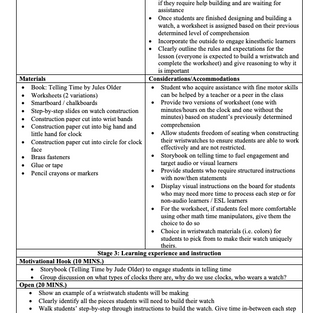
Beginning with the learning profile of Sherry, the first change I made to the lesson plan was adding in a story on telling time as a hook. It mentions that Sherry has a creative imagination and loves to read, which is why I thought adding in a storybook can help with Sherry’s comprehension with the lesson. By focusing more on Sherry’s characteristics, it allowed me to think of an additional teaching technique I had yet to incorporate into the lesson, which will benefit Sherry and others (Landrum & McDuffie, 2010). A storybook is an excellent tool to introduce a topic as it targets both visual and audio learners, as well as allows opportunities for the teacher to pause the story and discuss important points. Since Sherry is also functioning below grade level, a storybook is fun and unthreatening format to introduce a math topic. It is in a format that may allow Sherry an easier time at grasping the content presented. Other children can benefit as a storybook will engage their interest and start to get their minds flowing on what is significant in telling time (parts of a clock, where do we see time-telling devices, what activities involve telling time, etc.). For Sherry, I included now/then statements within the accommodation portion, as Sherry likes being told what to do. Now/then statements can make information more digestible and provides specific instruction on the order things should occur. For example, within the build a wristwatch lesson a sentence used can be; “Now we will use the brass fastener to secure the clock face to the wristband, and then we will wait for the next instruction.” Now/Then statements are a common accommodation found within IEPs, but can be extended to assist other students (Landrum & McDuffie, 2010).
Secondly, Jimmy is another example of a student who benefits from the storybook as he is a visual and audio learner (Landrum & McDuffie, 2010). Both learning styles are present within a storybook, allowing for higher understanding to occur. Although it is noted that Jimmy loses interest in new books and starts to fidget, a solution is to allow Jimmy to sit at his desk with a fidget toy when the story is being read. A fidget toy is a form of accommodation, which are typically assigned to student’s who have trouble staying still or focusing on one task (Landrum & McDuffie, 2010). The reason Jimmy would sit at his desk with the toy instead of the carpet with the rest of the students is to prevent other students from becoming distracted. If Jimmy is playing with the fidget toy, he might not be visually taking in the storybook information, but his audio can still be engaged. Other accommodations to assist Jimmy’s learning style is the pre-made example of the activity, demonstrating step-by-step instructions, and showcasing all the instructions on the smartboard. Mainly visual learning is targeted throughout these instructional strategies, but the audio would be noted in showing the students step-by-step how to build the watch. The last accommodations to support Jimmy is the choice in diverse seating. Jimmy is hyperactive and giving choice in diverse seating or letting Jimmy stand throughout the activity, can allow his mind to focus if his body is comfortable. Diverse seating can be categorized within the Universal Design of Learning (UDL) under appropriately designed space, as it can benefit more students than just Jimmy (Learning for All, 2013).
Thirdly, I found Terrence the hardest student to create differentiated instruction to best suit his needs. Terrence does not connect to school, so I chose a lesson focussing on real-life applications as I believe this will grasp his attention. To maximize Terrence’s learning, his interest needs to be invested for him to care about the material (Landrum & McDuffie, 2010). All lessons in school are important to learning, but many of them do not involve immediate use in a primary/juniors’ life outside of school. Telling time is noted outside of school as it is used to tell times of the day and is integrated into many activities, such as sports or cooking. Landrum and McDuffie (2010) explain that learning is greater when students understand the connection to real-life. Explaining this fact to the students can interest Terrance as he can see the instantaneous real-world application to it. In addition, this interest can encourage Terrance to complete this activity so he can have his wristwatch to wear and tell time with. Since Terrence is an intelligent student, giving him the more difficult worksheet to tell time can challenge his thinking, especially if a few questions above grade level are present.
Next, as for Jack, this activity is very beneficial as it doesn’t focus greatly on reading and writing. Although, these components are still present and being challenged as the worksheet instructions will be written on the page. Small amounts of words are less threatening to a student who is learning, but also does not excuse them from meeting that learning goal. By providing a doable challenge, Jack will be successful in learning and avoid negative emotions, such as failure (Learning for All, 2013). Also, Jack can follow along with the words in the storybook to associate sounds or pronunciation of words with their letters or spelling. Jack is a hands-on learner, as he enjoys handsy outdoor activity, which is why constructing a watch is a beneficial form of learning for him. Finally, as a fun bonus, the closing activity is to take students outside to show them how sundials work and discuss how time was once told. Jack thrives in the outdoors, which incorporating it may reinforce learning. It can be used as a reward to keep students on task with the activity. The various forms of learning present for Jack, such as storybook education, hands-on building, a worksheet, and a fun educational bonus involving outside, is an important part of differentiated learning, according to Tomilson (Landrum & McDuffie, 2010).
Finally, Marie will benefit from the clearly outlined instructions, step-by-step instructions, and construction steps posted on the whiteboard to ensure the wristwatch is being made correctly. Also, since Marie likes to excel, having outlined instructions posted can allow her to move ahead of the group if the step-by-step instructions are moving too slowly for her needs. In this case, the process of learning is differentiated for Marie (Learning for All, 2013). If Marie finishes building her watch early, then she can execute her leadership skills by assisting other students in building their wristwatches. Once the wristwatches are built, Marie would benefit from the above-grade-level worksheet focusing on telling time. By having a worksheet that is at grade-level and one above grade-level, it meets the flexibility and inclusivity portion of UDL (Learning for All, 2013).
Differentiated instruction is present throughout the lesson plan, as different components are designed to target different interests, types of learners, or ability Landrum & McDuffie, 2010). As an educator, it is important to get to know one’s students to be able to build effective lessons plans that can include an element to help each child develop their skills and further their learning. The lesson plan can include various processes, content, environments, or products of learning, which can aid in student’s success. Being able to think outside the box is an effective skill, as it allows for ideas to form which may be focused on one student but positively impact all. For example, the closing portion of the lesson where the students are taken outside to study a sundial. This closing piece was created with the thought of Jack’s learning profile in mind, but it is an activity which will interest the majority of students. Although the use of a sundial is not included in the school curriculum, it shows students the history of time, builds alternative connections with time and the real world, and provides a link to science and technology. In today’s society and moving towards the future of education, differentiated instruction or variations of it are significant in ensuring that all students are reaching their potential.
Work Cited
Landrum, T. J., & McDuffie, K. A. (2010). Learning styles in the age of differentiated instruction.
(2013) Learning for All - Chapter 2: Instructional Approaches


Comments