
Integrated Lesson Plan
- Hannah Weston

- Apr 8, 2020
- 4 min read
Physical Education and Social Science
Hannah Weston
8144625
PED3113A
Professor: Jennifer Rottmann
March 5th, 2020
Part One: Description
My placement is located at Roland Michener Public School (RMPS), which is located within Kanata. RMPS is unique, as it is a relatively small school with 165 students registered, ranging from kindergarten to grade six. In addition, RMPS is designed to promote community and connectedness with its open concept design. I am working within a grade two classroom with 23 students. My classroom, along with the rest of the school, has many students of various ethnicities and cultural backgrounds, which adds to our diversity. Within my practicum, I have two students who are English-Second Language (ESL) learners and two students with registered Individual Educations Plans (IEPs). The two students with IEPs are diagnosed with Attention Deficit Hyperactive Disorder, which affects their ability to focus and stay stagnant for long periods. IEPs and ESL accommodations are incorporated in my lesson plan, due to meeting the needs of my practicum students.


Reflection:
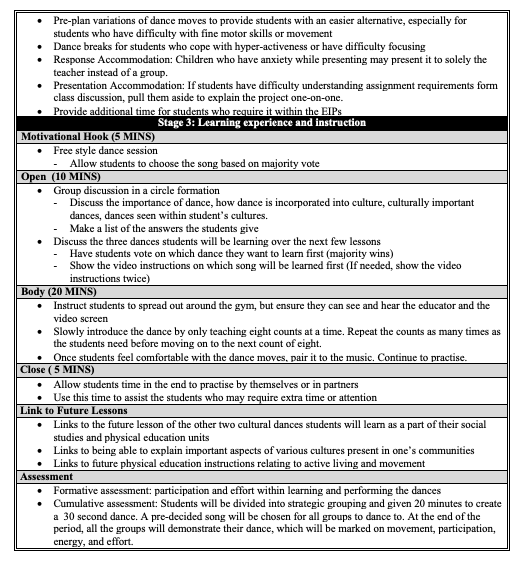
The following lesson is designed to target students who need extra support to achieve the learning goals, as well as provide equal opportunity for all students to complete components of the social studies and physical education curriculums. I begin the lesson with a few minutes of free dancing to allow students to shake out the extra energy they may have, which will hopefully allow them an easier time concentrating on the learning the moves to a new dance. This motivation hook is specifically created with the interest of students with ADHD in mind. Students with ADHD typically have difficulty focusing, which may affect their listening skills and understanding of the lesson. By providing a chance for them to release some energy in a form they choose, it may provide enough stimulation to allow them to concentrate on learning the dance moves after. Students are allowed to choose the first song they dance to, based on a majority vote. Ideally, by providing students with the choice to choose a song, they will feel included in the decision making. Secondly, the opening to the lesson is short but it allows the educator to reflect on the importance of dance in cultures and provide students with a platform to talk about why they think dance is significant or to relate their culture to the lesson. Record students answers to use as an anchor chart to enhance students’ learning. Also, discuss what the three dances students will be learning over the course of multiple lessons and allow them to choose which one to learn first. This choice will engage students in the process and allow their voices to be heard. Thirdly, the body involves teaching the dance moves, which may proceed as fast or slow as the students require. Repetition is crucial to enhance students understanding and to help them memorize the steps. Once the majority are comfortable with the moves, add in the music to provide the full experience. Lastly, the closing of the lesson allows students time to practise with their friends or individuals the moves they have learned. The closing is short to ensure students do not use the time to get off track and waste too much of their learning time. In addition, instructing students to work alone or in partners for the last little bit allows the educator a chance to monitor everyone progress and provided extra one-on-one attention to any student who may require help.
Next, the underlying goals of the lesson were focusing on the cultural significance of dance, which is noted in the majority of cultures, as well as dance as a physical exercise. Dance is important for self-express and can provide students will an alternative form of exercise, coping mechanism, or enjoyment. Also, dance contributes to the student’s ability to understand their bodies and coordinate movements.
For the majority of the lesson, students are together as one large group. I organized it in a manner to allow for group discussions to occur where everyone is involved and listening, which explains why we are learning cultural dances at school. A large group creates the most effective learning environment for learning the dance moves as all student can watch the educator and follow along together. The closing allows students to work individually or in pairs, due to some students preferring to work alone whereas others like to have a friend. In addition, I chose partners over small groups to prevent too many students from getting off task and not practising the movements.
The following lesson aligns with the ICI cohort principles as dance is an art form that thrives off of creativity. This lesson is innovative as instead of solely using discussion and assigning students worksheets, it allows students to learn through movement to comprehend the significance of dance in cultures. Finally, with the summative assessment where students will create their own dance that they believe represents themselves, it involves imagination. Students will need to use their ideas concerning dance and what they have learned to create their own dance.
The original idea came from a lesson I learned in elementary school where we learned how to hula dance. This memory of my education led me to look into the social studies curriculum for grade two to discover components of cultural learning, which could be integrated with the physical education curriculum. In addition, my associate teacher had recently asked me on ideas of how to teach dance to the students, which prompted me to tailor my lesson plan towards my grade two class. Hopefully, I will have the chance to utilize it during fulltime practicum. Overall, the integrated lesson plan was quite fun to plan and encouraged me to think outside the box by combining two curriculums together.
References:
Ministry of Education. (2019). The Ontario Curriculum Grades 1-8 Health and Physical Education. Retrieved February 24th, 2020, from http://www.edu.gov.on.ca/eng/curriculum/elementary/2019-health-physical-education-grades-1to8.pdf
Ministry of Education. (2013). The Ontario Curriculum Grades 1-6 Social Studies. Retrieved February 24th, 2020, from http://www.edu.gov.on.ca/eng/curriculum/elementary/sshg18curr2013.pdf

Comments