
Math / Science Lesson Plan Reflection
- Hannah Weston

- Jan 7, 2020
- 4 min read
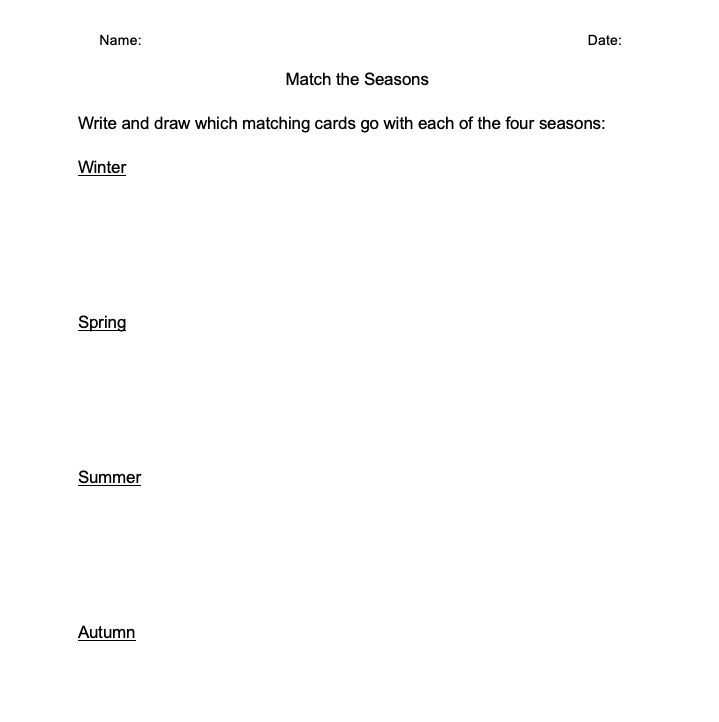
The lesson we planned was an activity for Grade 1 science students, which was categorized under the Understanding Earth and Space Systems: Daily and Seasonal Changes unit. The goals of our lesson were to provide students with the opportunity to understand and analyze the main differences between the four seasons throughout a typical year in Canada. We developed a matching game requiring critical thinking about various concrete, general weather conditions, and activities correlated with each season. Students were split into pairs and given 16 cards face-down. Each card showed a different image with its corresponding term/name, which symbolized on of the seasons (two sets of cards per season). Students turned over two cards each round, and if both cards represented the same season, then the student would remove them from the game. Students exercised their memory skills and had to think logically about which season each picture corresponded with on the cards. After the game, a worksheet was provided for students to draw / write which cards corresponded with each season.
Moreover, the activity addresses the Big Idea in the Grade One curriculum of seasonal changes and their effects on humans. As seasonal and daily weather changes are a main component of the big ideas and the overall expectations for this unit, we addressed seasonal changes throughout the many cards for our activity. At the end of our activity, we emphasized that the general weather conditions we discussed of a particular season are not exactly the same every day. We explained how many of these changing weather conditions are primarily controlled by the sun. Also, the activity had students match and thus clearly see the relationship between the clothing, weather conditions, and activities one would participate in during each season. Therefore, students had the opportunity to comprehend the first overall expectation of the unit, which is how these daily and seasonal changes impact human life.
In our design and presentation of the activity, we used the chalkboard for the introduction to write down students’ thoughts on the seasons. The main activity was presented as a card game, and finally, a worksheet was ideal to help form the connection between weather, activities, or clothing for each season. We used colorful pictures and cards to make the activity more vibrant for young primary students. Overall, what changed our perspective about science was seeing how concepts can be taught using fun, interactive activities. It was enjoyable to teach science using real-world contexts for students, as it made the lesson easier to understand. In addition, it allowed students to view science as a less intimidating or complex subject.
Many times, the connections between the real world and subjects are overlooked, as these elements appear in everyday life. The connection between the four seasons as a science subject seemed odd, as the seasons influence mundane aspects, such as clothing choice or the weather. Reading the first-grade science curriculum was a significant aid in linking the four seasons and weather changes as a subject of science. It explained the components of the seasons not typically thought about, such as daylight savings, reasons for weather changes, the sun's proximity to earth, and climate differences. These factors are visibly related to science, which allowed for the relationship between science and the real world to form.
The major portion of inquiry throughout this assignment was creating an initial idea, but then continuously revising it until we felt it was age appropriate. This struggle required us to truly consider how a grade one would think, and how student's pre-developed knowledge would aid them in completing the lesson. The initial project was above grade one level ability, leading to a simpler version. Once again, reading the different requirements based on grade levels in the curriculum helped to answer questions concerning if the lesson met the criteria.
The most surprising factor of the lesson was the different responses to the two learning activities we created. Groups were positively responsive to the matching card game concerning the seasons. Even in moments of uncertainty, participants still appeared engaged, as they had to think about what picture represented each season critically. In one case, the image of a flower garden could be categorized as spring or summer, which confused a few people. Players had to carefully analyze the cards to discover that the flower garden was supposed to be for spring, as that was the season it fit best. We noticed this trend throughout the three groups that completed our lesson and discussed changing that photo to prevent confusion for grade ones. In comparison, participants were not thrilled about having to copy the words from the matching cards and write them under the correct season on the worksheet. It was requested they draw a photo to represent the word as well, which participant did not enjoy. Considering this reaction, we think it may be due to age, whereas a child would be more receptive to having to draw out a picture.
To conclude, the big ‘aha!’ moment revolves around incorporating music into the lesson while the students completed their activities. The classical composition piece, Four Seasons, by Antonio Vivaldi, is a musical expression of how Vivaldi heard the four seasons, which tied to the theme of our lesson. The incorporation of classical music while students worked provided another element to multimodal learning, as well as appealed to audio learners. Also, classical music allows students to focus on the sound without taking about from their thinking or learning process, which occurs with social talking or other genres of music. It was a small, last-minute decision, which provided many benefits to students and made the lesson more enjoyable for all.
Comments